Computing in Basic Education - Computational Thinking, Digital World, and Digital Culture
The inclusion of Computing in basic education was initially foreseen in Resolutions CNE/CP 02/2017 and CNE/CP 04/2018 in all stages of education. On February 17, 2022, the opinion on the Norm for Computing in Basic Education – Complement to the National Common Curricular Base (BNCC) and the Tables of Skills and Competencies were approved with praise and unanimously by the National Education Council (CNE).
The norm was approved on September 30, 2022, by the Ministry of Education (MEC) and published in the Official Gazette of the Union on October 3 of the same year.
The Resolution CEB 01/2022 defines the standard as a complement to the BNCC and provides other guidelines, such as: curriculum development by networks, initial and continuing teacher training, implementation deadline, and the establishment of public policies. The resolution came into effect on November 1, 2022, setting a one-year deadline for educational networks to adapt. In other words, as of November 1, 2023, Computing in Basic Education became a right for all and not a privilege for some.
In parallel, the National Digital Education Policy (PNED) was processed in Congress and sanctioned by the president on January 11, 2023.
The Law No. 14.533/23 which created the PNED, also amends Article 26 of the Law of Directives and Bases of National Education (Law No. 9394/1996), including the teaching of computing, programming, robotics, and other digital skills as a new curricular component in elementary and high school.
The eighth article of the LDB was also amended, including the evaluation of digital literacy and education in schools and higher education institutions.
In addition, the PNED aims to facilitate adequate teacher training and funding, adaptation of undergraduate course curricula, offering of Computer Science undergraduate courses, development of teaching materials, provision of adequate equipment and internet for schools, and other referrals.
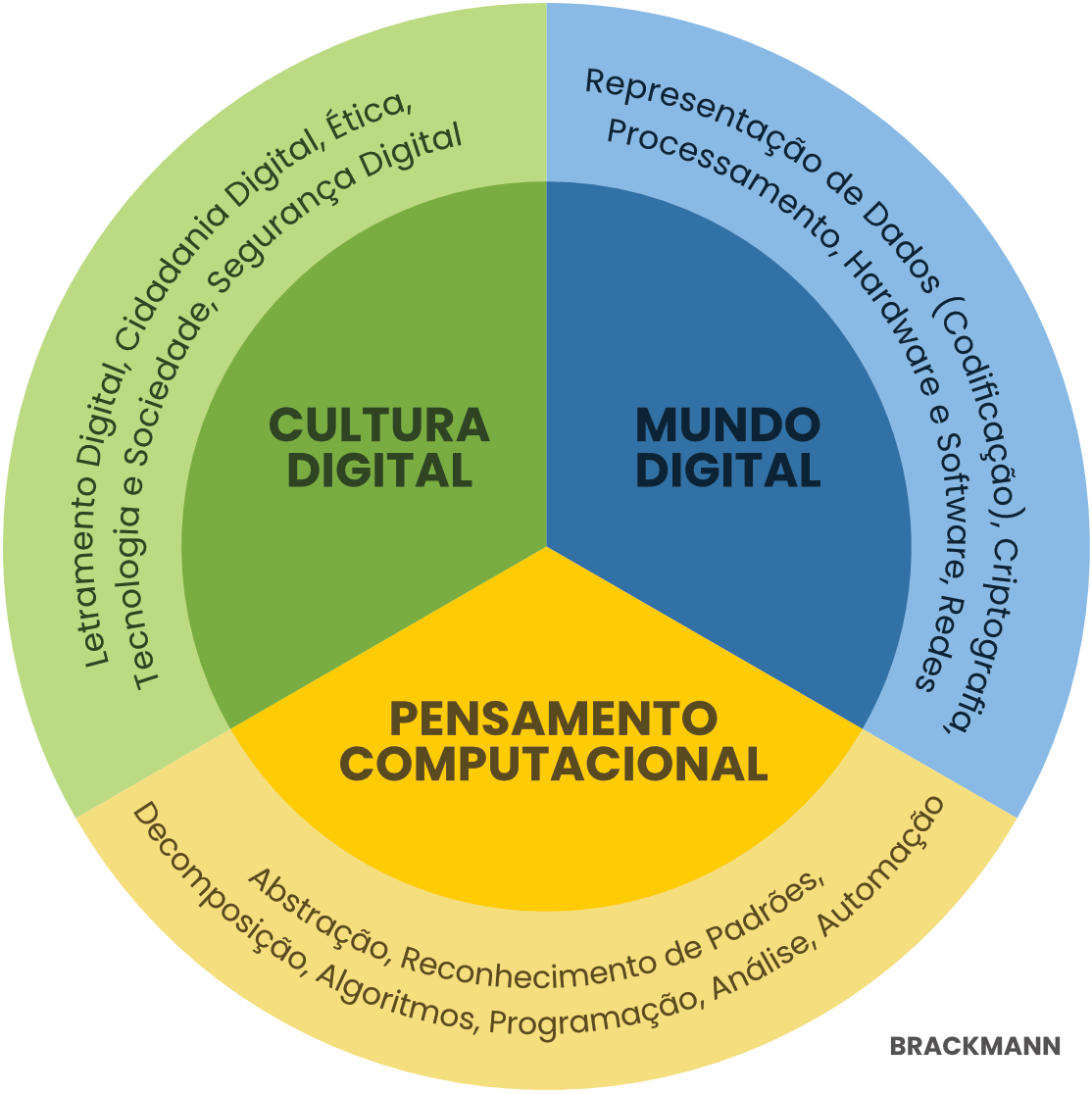
Computing in Basic Education is organized into three axes:
Digital Culture: Concerns the understanding of the impacts of the digital revolution and advances in the digital world on contemporary society, the construction of a critical, ethical, and responsible attitude towards the multiplicity of media and digital offerings. Also regarding the uses of different digital technologies and the content disseminated. It also refers to fluency in the use of digital technology efficiently, contextually, and critically.
Digital World: Understands digital artifacts – physical (computers, cell phones, tablets) and virtual (internet, social networks, programs, data clouds). Digital world concerns information, storage, protection, and the use of codes to represent different types of information, ways to process, transmit, and distribute it safely and reliably.
Computational Thinking: Set of skills necessary to understand, analyze, define, model, solve, compare, and automate problems and solutions methodically and systematically through the development of the ability to create and adapt algorithms. It uses the foundations of computing to leverage and enhance learning and creative and critical thinking in various areas of knowledge. (other definitions)
Opinion CNE/CEB No. 2/2022
February 17, 2022
[how to reference]
Brazil. Ministry of Education. Opinion of the National Council of Education (CNE)/Basic Education Chamber (CEB) No. 2/2022. Standards on Computing in Basic Education - Complement to the National Common Curricular Base. Brasília: MEC, 2022. Available at: https://bit.ly/computacao_parecer. Accessed on: Oct 17, 26.
|  |
Resolution CEB 01/2022
of October 04, 2022
[how to reference]
Brazil. Ministry of Education. Resolution of the Basic Education Chamber (CEB) 01/2022. Standards on Computing in Basic Education - Complement to the National Common Curricular Base. Brasília: MEC, 2022. Available at: https://bit.ly/computacao_resolucaoCEB. Accessed on: Oct 17, 26.
|  |
Tables of Skills and Competencies
[how to reference]
BRAZIL. Ministry of Education. Annex to the Opinion of the National Council of Education (CNE)/Basic Education Chamber (CEB) No. 2/2022. Standards on Computing in Basic Education - Supplement to the National Common Curricular Base. Brasília: MEC, 2022. Available at: https://bit.ly/computacao-tabelas. Accessed on: Oct 17, 26.
| 
|
Tables of Skills and Competencies
(open pages / A4 version)
[how to reference]
BRAZIL. Ministry of Education. Annex to the Opinion of the National Council of Education (CNE)/Basic Education Chamber (CEB) No. 2/2022. Standards on Computing in Basic Education - Complement to the National Common Curricular Base. Brasília: MEC, 2022. Available at: https://bit.ly/computacao-tabelas. Accessed on: Oct 17, 26.
|
 |
Tables of Skills and Competencies
[how to reference]
Brackmann, C. Computational: Computing Education. Online version of the annex to the Opinion of the National Council of Education (CNE)/Basic Education Chamber (CEB) No. 2/2022. Standards on Computing in Basic Education - Complement to the National Common Curricular Base. 2024. Available at: http://euvou.net/bncconline. Accessed on: Oct 17, 26.
|
 |
BNCC Computing GPT
(BETA version)
[how to reference]
Brackmann, C. BNCC Computing. OpenAI GPT trained with the annex to the Opinion of the National Council of Education (CNE)/Basic Education Chamber (CEB) No. 2/2022. Standards on Computing in Basic Education - Complement to the National Common Curricular Base. v2. 2024. Available at: https://euvou.net/gptbncc. Accessed on: Oct 17, 26.
|
 |
Connected Education Innovation Policy (PIEC)
Law No. 14,180, of July 01, 2021
[how to reference]
Brazil. Connected Education Innovation Policy (PIEC). p. 3, Jul 1, 2021. Available at: https://www.planalto.gov.br/ccivil_03/_ato2019-2022/2021/lei/l14180.htm. Accessed on: Oct 17, 26.
|  |
National Digital Education Policy (PNED)
Law No. 14,533 of January 11, 2023
[how to reference]
Brazil. National Policy for Digital Education (PNED). p. 5, Jan 11, 2023. Available at: https://www.in.gov.br/web/dou/-/lei-n-14.533-de-11-de-janeiro-de-2023-457334986. Accessed on: Oct 17, 26.
|  |
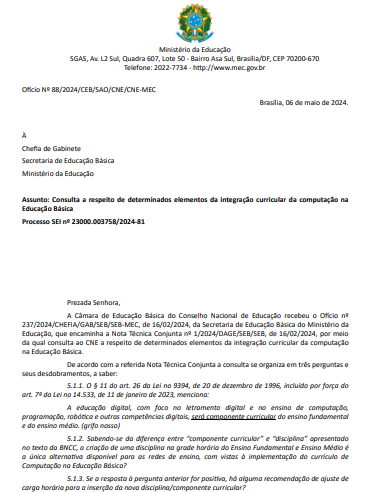
Official Letter 88/2024/CEB/SAO/CNE/CNE-MEC/2024
The document discusses whether Computing should be considered
a specific discipline or a transversal curricular component.
[how to reference]
Brazil. National Council of Education (CNE). Official Letter No 88/2024/CEB/SAO/CNE/CNE-MEC. May 6, 2024. Available at: https://www.computacional.com.br/files/Implementacao/Brasil%20-%20Oficio%20SEI_MEC%204872119.pdf. Accessed on: Oct 17, 26.
| 
|
CNE/CEB Resolution No. 2 of March 21, 2025
Establishes the National Operational Guidelines on the use of digital devices in school spaces and the curricular integration of digital and media education.
[how to reference]
Brazil. National Council of Education (CNE). CNE/CEB Resolution No 2. March 21, 2025. Available at: https://www.computacional.com.br/files/Implementacao/Brasil%20-%20Resolucao_CNE_CEB_02-2025.pdf. Accessed on: Oct 17, 26.
| 
|
Teacher Digital Knowledge
Framework for the use of digital technologies in teaching and learning processes of Elementary and High School, in order to contribute to the achievement of the objectives of: PEIC (Law No. 14,180/2021) and PNED (Law No. 14,533/2023),
[how to reference]
Brazil. Teacher Digital Knowledge. Brasília, DF: MEC, 2024. Available at: https://www.computacional.com.br/files/Implementacao/MEC_-_Saberes_Digitais_Docentes.pdf. Accessed on: Oct 17, 26.
| 
|
Fundação Telefônica Vivo
Recommendations for the Implementation of BNCC Computing
[how to reference]
Brackmann, Christian; Campos, Flávio. Martins, Amilton. Audino. Telefônica Vivo Foundation - Recommendations for BNCC Computing Implementation. 2024. Available at: http://dx.doi.org/10.13140/RG.2.2.29529.02403. Accessed on: Oct 17, 26.
| 
|
Fundação Telefônica Vivo
Guiding Document for updating the Curricular Reference
[how to reference]
Brackmann, Christian; Campos, Flávio. Martins, Amilton. Audino. Telefônica Vivo Foundation - Guiding Document for updating the Curricular Framework. 2024. Available at: http://dx.doi.org/10.13140/RG.2.2.32045.60646. Accessed on: Oct 17, 26.
|  |
UNDIME, Fundação Telefônica Vivo, CIEB et al.
Connectivity and BNCC Computing Guide in Municipal Curricula
[how to reference]
Telefônica Vivo Foundation. Connectivity and BNCC Computing Guide for Municipal Curricula. 2025. Available at: http://dx.doi.org/10.13140/RG.2.2.16032.90889. Accessed on: Oct 17, 26.
|  |
Canvas: BNCC Computing Implementation
Guidelines on how to use the Canvas
[how to reference]
Brackmann, Christian; Campos, Flávio. BNCC Computing Implementation Canvas. 2023. Available at: https://bit.ly/3LULR4w.
|
Print Version
Online Version
 |
Discover the Curriculum Framework in
Artificial Intelligence in Basic Education
This is the first proposal to organize competencies and
skills, initiating a debate on their use for
basic education. It is not an official document.
[how to reference]
VICARI, Rosa Maria; BRACKMANN, Christian; MIZUSAKI, Lucas; LOPES, Daniel; BARONE, Dante; CASTRO, Henrique. Curricular Framework: Artificial Intelligence in High School. Porto Alegre: UFRGS/IFFAR, 2022. Available at: https://inf.ufrgs.br/ciars. Accessed on: Oct 17, 26.
|
|
Also check out the Technology and Computing Reference Curriculum from the Center for Innovation in Brazilian Education (CIEB)
Its main objective is to support school networks and schools in including technology and computing themes in their curricular proposals. The curriculum covers from Early Childhood Education to Lower Secondary Education, for the implementation of practices that help develop in students competencies and skills related to technology and computing. Learn more